Defect tracking vs bug tracking vs issue tracking: what's the difference?
Three names for tools that mostly do the same job. Where the words genuinely differ, where they don't, and what to look for whichever one you're shopping for.
Defect tracking, bug tracking and issue tracking describe the same core job — record a problem, prioritise it, assign it, follow it to closed. The real difference is scope: a defect or a bug is one kind of problem in software, while an issue can be a bug, a task, a feature request or a question. Choose by what you need to track, not by which word is on the box.
If you have searched for a tool recently you have met all three phrases, sometimes on the same page. It is fair to wonder whether you are comparing different products or the same one under different labels. Mostly it is the second, with a few real differences worth knowing about.
Three words, three scopes
| Term | What it usually covers | Where you hear it |
|---|---|---|
| Defect tracking | Software that doesn't meet its requirements, found in testing or in use | QA and testing teams, regulated or process-heavy environments |
| Bug tracking | Anything in the software that behaves wrongly | Developers, small teams, open source projects |
| Issue tracking | Bugs, and also tasks, feature requests, questions and other work | Project teams, support teams, general-purpose tools |
Defect is the formal word. It implies a requirement the software failed to meet, which is why it turns up where someone has written the requirements down and someone else is testing against them. Bug is the working developer's word for the same thing, without the paperwork. Issue is the widest: it holds bugs, but it also holds anything else that needs an owner and a status.
Why the labels feel inconsistent
Because products name themselves by heritage rather than by definition. Bugzilla and MantisBT started as bug trackers and say so. Jira and Redmine call their records issues because they grew to hold more than bugs. Tools aimed at testers lean on defect. None of that reflects a technical standard, so two products with different labels can be near-identical and two with the same label can be very different.
Search terms follow the same drift. People looking for a defect tracking system and people looking for a bug tracker are usually after the same thing, and the phrase issue management software is most often a synonym for issue tracking, though some vendors use it for larger tools with workflow rules and reporting layered on top.
What matters whichever word you use
The label tells you very little. These are the things that decide whether a tool will work for you:
- Status you can trust. A short, clear set of states — open, in progress, fixed, closed — beats a dozen custom ones nobody remembers.
- One priority field. Enough to sort by, few enough to stay meaningful. We explain why in bug severity vs priority.
- One owner per item. A problem assigned to a group is assigned to nobody.
- Comments and screenshots on the item itself, so the discussion travels with the bug rather than living in chat.
- Search and filters that get you to "open and unassigned" in a click — the basis of a weekly triage.
- Access control. Who can read, who can file, who can change things — especially if clients or contractors will use it.
- Notifications that point at the tracker. Email or Slack alerts are useful when they link back to the bug and harmful when they replace it.
Which kind should you pick?
If what you track is mostly bugs
Choose a bug-focused tracker. Less to configure, less to learn, and nothing on screen that isn't about the problem in front of you. This covers most solo developers, freelancers and teams of up to about twenty.
If bugs are one type of work among many
Choose a general issue tracker. If the same tool needs to hold feature work, tasks, sprints and a roadmap, a bug-only tool will feel narrow. Jira is the best-known example and it earns its complexity in that setting. Our comparison of Jira bug tracking and BugTrack lays out where each fits.
If you test against written requirements
Choose a defect tracking or test-management tool. If you need to link each failure to a requirement and a test case, and show that trail to an auditor, you are in process-heavy territory and a lightweight tracker won't give you that.
Where BugTrack sits
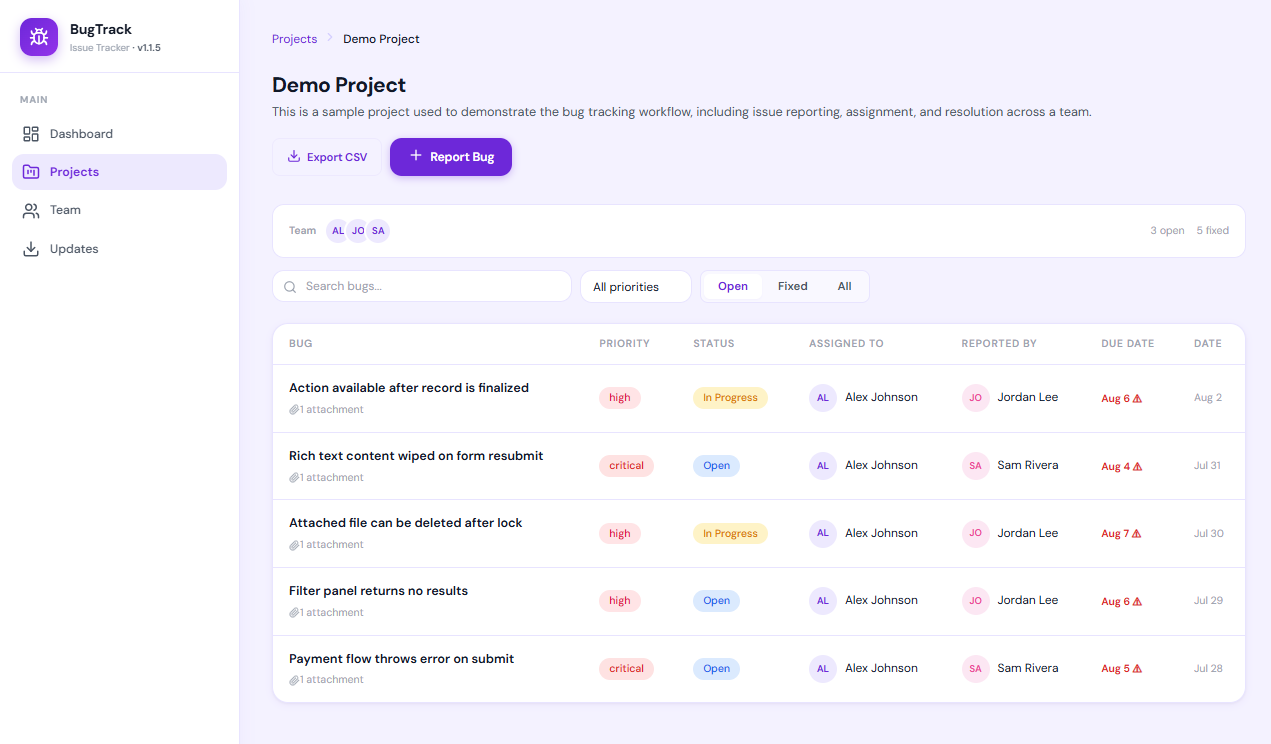
BugTrack is deliberately a bug tracker: projects, four statuses, four priorities, one assignee per bug, comments, attachments, roles and Slack or email alerts. It does not try to be sprint planning or a product roadmap. It is self-hosted, so the data stays on your own server, and free to run. If your work is mostly finding and fixing bugs, that narrow scope is the point. If you need project management as well, look at a general issue tracker instead.
Frequently asked questions
What is the difference between defect tracking and bug tracking?
Very little in practice. "Defect" is the more formal word, common in QA and testing teams, and it usually means the software does not match its requirements. "Bug" is the everyday word for the same thing. Tools sold as defect tracking systems and bug trackers do essentially the same job: record a problem, give it a priority and an owner, and follow it to closure.
What is issue tracking software?
Issue tracking software records units of work and problems and follows them through statuses to completion. "Issue" is the broadest of the three words: it can mean a bug, a task, a feature request or a support question. A bug tracker is an issue tracker limited to one kind of issue.
What is issue management software?
Usually another name for issue tracking software. Some vendors use it for larger tools that add workflow rules, service-level timers or reporting on top of basic tracking, but there is no fixed definition, so check the feature list instead of the label.
Is Jira a bug tracker or an issue tracker?
Jira is a general issue tracker with project-management features such as boards and sprints. Many teams configure it as a bug tracker, and it is often used that way, but bug tracking is one use of it rather than its whole purpose.
Do small teams need a defect tracking system?
They need somewhere to record bugs with a status, a priority and an owner, which is what a defect tracking system provides. They rarely need traceability matrices, test-case management or custom workflows. A simple bug tracker covers the need for a team of one to twenty.
A bug tracker without the overhead
BugTrack is a free, self-hosted issue tracker for individuals and small teams. One priority field, four statuses, one owner per bug — ready in about fifteen minutes.
Download free →